

Here is what nobody tells you about becoming a builder. When you cross a certain threshold in your relationship with AI, your fundamental relationship to time changes.
The gap between what you can envision and what you can produce genuinely closes because what used to take a week of concerted effort now takes forty-five minutes of focused prompting and editing. The ideation phase, previously bounded by the physical time required to draft, research, and format, suddenly collapses. You hold a concept in your mind, and within minutes, you are looking at a highly structured articulation of that concept. The cognitive load shifts entirely from generation to evaluation.
This shift runs deep, and it is also disorienting.
The learning curve catches you off guard, certainly, but I think the patience problem is the actual challenge. You find yourself operating at a speed that feels entirely natural to you now. However, you are still inhabiting an institution that was built for the speed you left behind.
Multiply that private impatience by a workforce, and it becomes an institutional physics problem. The modern organization is currently bifurcated. On one side, you have teams and individuals operating at 10x speed, generating proposals, data analyses, and strategic plans with astonishing fluidity. On the other side, you have the institutional machinery. The compliance checks, the committee reviews, and the legacy processes are grinding along at the exact same pace they always have. We are feeding high-velocity output into low-velocity systems. The machinery is beginning to smoke in Higher Education and Non-Profits (so I’d imagine it’s fully on fire in some corporate settings).
The mechanism of this institutional illusion is predictable. A single node in the network adopts the tools and dramatically increases their output, submitting five proposals a week instead of one. The surrounding nodes, operating at legacy speeds, receive this output and become a catastrophic bottleneck. The cost of this failure is severe organizational burnout. The fast node feels constantly blocked and unappreciated, while the slow nodes feel constantly overwhelmed and under siege. The organization has not increased its velocity. It has simply relocated its friction to the points of intersection.
What I’m often experiencing in those honest hallway moments (of in my case virtual coffee chats) is that most executive conversations about this transition focus entirely on the wrong things. Leadership teams spend their retreats talking about vague anxieties regarding comfort and adoption. They worry about whether the staff feels supported, treating a structural fracture as a mere morale issue. The small, expensive problem that is costing universities and non-profits millions of dollars in wasted friction is managing the speed gap before it tears the organization apart. This is about change management as much (or probably more than) it is about AI.
The danger of the speed gap is that parts moving fast make the whole feel fast. When the strategic planning committee generates a draft in two days instead of two months, the institution feels like it is accelerating. Movement, however, does not equal destination. If that draft still takes six months to clear the faculty senate, the institutional velocity has remained static; only the distribution of the waiting period has shifted. The test of leadership in this moment is capturing the converts’ speed without shattering the defenders’ rigor.
The Zealous Convert
When someone first discovers what AI can genuinely do, they tend to become, briefly, insufferable. (Or in my case, entirely insufferable!) This happens in the moment when something clicks and the machine performs a task of real cognitive weight.
I know this because at this point I have lived through multiple rounds of insufferable phases. My enthusiasm has been entirely sincere. I had spent years learning to do things slowly, and suddenly the constraints were gone. I reorganized my entire worldview around what the tools made possible. I began offering three-day estimates for three-month plans. I treated hallucinated competence as actual capability (on more than one occasion). I asked my colleagues if they had tried prompting the machine for their problems more often than anyone around me would prefer.

The Zealous Convert believes that because they can generate material faster, the institution can absorb and act on that material faster. They mistake volume and speed for quality. The model produces text that looks structurally identical to expert output. The Convert reads it, recognizes the polish, and assumes the underlying logic is sound because the syntax is flawless. They begin promising proposals outside their actual domain expertise, assuming the machine can bridge the gap. When a three-day estimate for a three-month plan is accepted, the inevitable failure damages both the project and the institutional trust in the individual.
We have begun to measure the trajectory of this archetype. In a longitudinal study spanning 2023 to 2025, Qing Xiao, Hancheng Cao, and their colleagues followed a project-based software development organization through the full arc of AI adoption. They tracked how the teams used and talked about the tools across two years, long enough to watch the early promises of systemic transformation meet the realities of daily work.
The findings documented a stark deflation of the initial promise of transformation. Early imaginaries positioned AI as a profound team transformer, a partner that would reshape how the organization tackled complex, shared problems and distributed collaborative cognitive load. Over the two years, the researchers watched those grand visions domesticate into isolated, individual productivity add-ons. The overarching team-level workflows remained stubbornly untouched. Individual contributors used the systems privately to complete their own discrete tasks faster, optimizing their personal queues without fundamentally altering the architecture of the team’s collaboration.
The lesson for leaders watching their own converts is that enthusiasm rarely translates directly into institutional throughput. The org-level velocity story deflates into private convenience when it lacks a systemic redesign of how work actually moves through the organization. The Zealous Convert has discovered a profound shift in individual capability, but what they have not yet built is the equanimity of living with the change long enough to know its costs. They fail to see that optimizing a single node in a complex system inevitably creates traffic jams at the adjacent nodes.
The Legacy Defender
On the other side of the speed gap is the colleague who simply will not engage. Every organization has one, and every convert has experienced the distinct frustration of trying to hand them a tool that would solve their immediate problem, only to be met with a polite refusal.

I’ll admit that I initially assumed folks fitting into this part of my typology were romanticizing inefficiency. I thought they were mistaking the pain of manual effort for the rigor of serious work. The Legacy Defender often presents this way, clinging to processes that seem visibly broken to anyone who knows what the new tools can do. Dismissing their resistance as technophobia, though, is incomplete as a diagnosis. The resistance is far more rational than the converts want to admit.
The mechanism of this resistance becomes clear when you examine the nature of the tool. A transparent instrument is a hammer; you know exactly how the force transfers. An opaque independent agent is a black box; you feed it inputs and it hands you an output, but the logic connecting the two is concealed. Philosophical reflection on technology in the 20th century from Martin Heidegger to John Searle have given us plenty of ways to frame this difference.
For a professional whose entire identity is built on demonstrating the ‘why’ behind a decision, the black box is an existential threat. When a registrar relies on an opaque system to evaluate transfer credits, and a student appeals the decision, the registrar cannot defend the logic. The institution loses its ability to explain itself to its stakeholders, replacing reasoned judgment with algorithmic fiat. AI scales the problem of “you don’t know what you don’t know,” making it much more difficult to manage.
In a 2024 empirical study published in the Lomonosov Economics Journal, Petrovskaya and Demchenko examined the conditions under which workers actually trust algorithmic management. Their setting was a sales force, an environment of highly visible metrics and direct pressure, where an algorithmic system evaluated and directed the representatives’ work.
The pattern in their data turns on interpretation. When the reps read the system as a transparent instrument, something they could understand and appeal against when they spotted an error, trust and acceptance held. When the same oversight read as an independent agent with opaque rules, making consequential decisions with no clear mechanism for correction, trust eroded sharply, and with it the felt legitimacy of every evaluation the system produced.
Legacy Defenders are responding to opacity, not novelty. Their resistance is a rational defense mechanism against a system that demands compliance without offering transparency. When they refuse to engage with a new AI workflow, they are refusing to be held accountable for a process they are not permitted to understand, leaving them to bear the consequences of decisions they cannot challenge. That is a wholly rational response.
This tension between accountability and opacity goes far deeper than workflow preferences. Anne-Sophie Mayer, Elmira van den Broek, and Tomislav Karačić tracked it across three organizations in fieldwork running from 2018 to 2025, each researcher embedded in a different setting. They followed loan consultants inside a German bank of 135,000 employees, seed sorters at a global plant-breeding company, and recruiters in a consumer goods firm of 200,000. In each case, management had handed a high-stakes judgment to an AI system: who gets the loan, which seed batch ships, which candidate advances. In each case, the experts lost the power to overrule the decision and kept the obligation to defend it to the person sitting across from them.
What the bank’s consultants did with that obligation should unsettle anyone planning a rollout. The system’s rulings frequently made no sense to them. One consultant described an applicant with above-average income and no debt whose loan was rejected, the machine’s summary offering only “unstable financial situation” by way of reason. Rather than admit they could not account for the outcome, consultants concealed it. They kept the screen turned away from the customer and supplied reasons drawn from their own experience instead: a new income threshold, a shift in the currency market, an entry on the credit file the applicant must have forgotten. The researchers named the practice masking. One consultant explained its appeal without embarrassment: “How should the customer know?”
The customers sensed something was off. One was told his application failed on credit history and replied that he had no outstanding debts; the consultant insisted there must be an entry he was unaware of, and the customer said “Mhm, okay, weird” and left. Because a person applies for a loan once every several years, the consultants received almost no corrective feedback and never revised the practice. The customers simply tried a different bank. By the final field visit in 2025, the bank’s own management had traced the damage: the personal consultation, the very thing that justified maintaining branches, had stopped being worth the trip.
This is the tension every experienced registrar, grant writer, and academic advisor can feel coming. You bear the burden of owning a decision you did not make and cannot explain, and the cheapest way out is to invent an explanation. The Legacy Defender is fighting the erosion of their professional accountability, and the bank consultants show what that erosion produces once the fight is lost. The leadership trap is treating these two archetypes as an HR problem, refereeing the conflict between the Convert and the Defender instead of advancing the mission. The goal must be designing a system where the tool can be used without triggering the rational resistance that opacity produces.
The Institutional Dopamine Trap
I have a private confession as a builder that scales up to a massive organizational vulnerability. It’s related to, but slightly different from, what we have described so far. The more I build, the more I find the cycle of generating, refining, and producing with a capable AI system elicits a particular kind of satisfaction that can become its own end. You are moving. Things are being made. The output is accumulating. It feels exactly like work in the best sense. It is dopamine wearing the clothes of productivity.
Historically, generating a fifty-page strategic report cost weeks of labor. That sheer cost acted as a natural cost-of-creation filter; you only commissioned the report if you absolutely needed it. When AI drops the production cost to zero, the filter vanishes. The mechanism of the trap is that the brain reads the production of the artifact as the completion of the work. You generate the report, you feel the dopamine hit of a finished task, and you send it to the committee. The committee now has to read a document that did not need to exist, spending their expensive human attention to parse cheap machine text. This is our cultural anxiety about AI slop in a nutshell.

So the friction that used to force you to slow down and ask whether something was worth making has been eliminated. The result of this is that the discipline of deciding what is worth producing has become an even more critical leadership function than it was before. Without friction and without discipline, the institution scales noise as easily as signal, filling shared drives and inboxes with perfectly formatted, grammatically correct irrelevance. The institution drowns in its own frictionless output.
Marios Constantinides and his colleagues named this condition in their 2025 CHIWORK paper: the future of work is blended, not hybrid. Their argument is that “hybrid,” their language for alternating between human work and machine work, no longer describes what actually happens. This is really, really important. The idea that the system generates the initial draft, the human edits it, and the system refines those edits into a final polish, sounds like it would be alternating hybrid work but it isn’t. Instead it blends the human and machine layers. And the machine layers have become so smooth that it is not easy (or I would add fair or useful) to pull apart what is distinctively human and distinctively machine in some sort of alternating pattern. Human and machine work are inseparable.
And once contributions are inseparable, the fundamental organizational concepts of authorship, credit, and accountability come under strain. Nobody can say who owns the final product. The distinction between human intent and machine generation dissolves into a polished artifact that bears no trace of the struggle required to produce it. Much of the banter in circles like Substack with its AI checker boil down to critiquing this point: flagging something as “produced by humans” or “produced by AI” doesn’t actually tell me anything about the quality of the work itself. Instead, it taps into a pre-existing bias I have (for good or ill) about what value is communicated by something being produced by humans or by AI.
The institutional version of this phenomenon, though, is the dangerous reality of not knowing which work is load-bearing. When every document looks authoritative, teams struggle to distinguish between a casually generated summary and a rigorously vetted strategic analysis. The dopamine hit of rapid production masks the fact that the organization is scaling noise, filling shared drives with material that possesses the aesthetic of rigor but none of the substance.
The seduction inside this dopamine trap has measurable mechanics. In a 2025 study published in the Journal of Management Studies, Dominik Siemon and colleagues examined social presence, the degree to which an AI system projects human-like collaborative qualities, and its relationship to worker motivation and reliance during shared tasks.
They found that higher social presence goes with higher motivation and a greater willingness to depend on the AI teammate, an effect moderated by how familiar and understandable the system is to the worker. A system that feels like a supportive colleague invites the kind of reliance people extend to colleagues — and that reliance arrives whether or not the system has earned it.
The Institutional Dopamine Trap is, in that light, a designed experience. The systems are built to feel helpful, responsive, and collaborative, and that feeling does real work on the people using them. Leaders should read the trap accordingly: workers are responding to an interface engineered to be depended upon, not failing a test of discipline. Mitigation is structural: interventions that reintroduce critical distance between the worker and the output.
Convert vs. Defender: What They See, What They Miss, What They Cost You
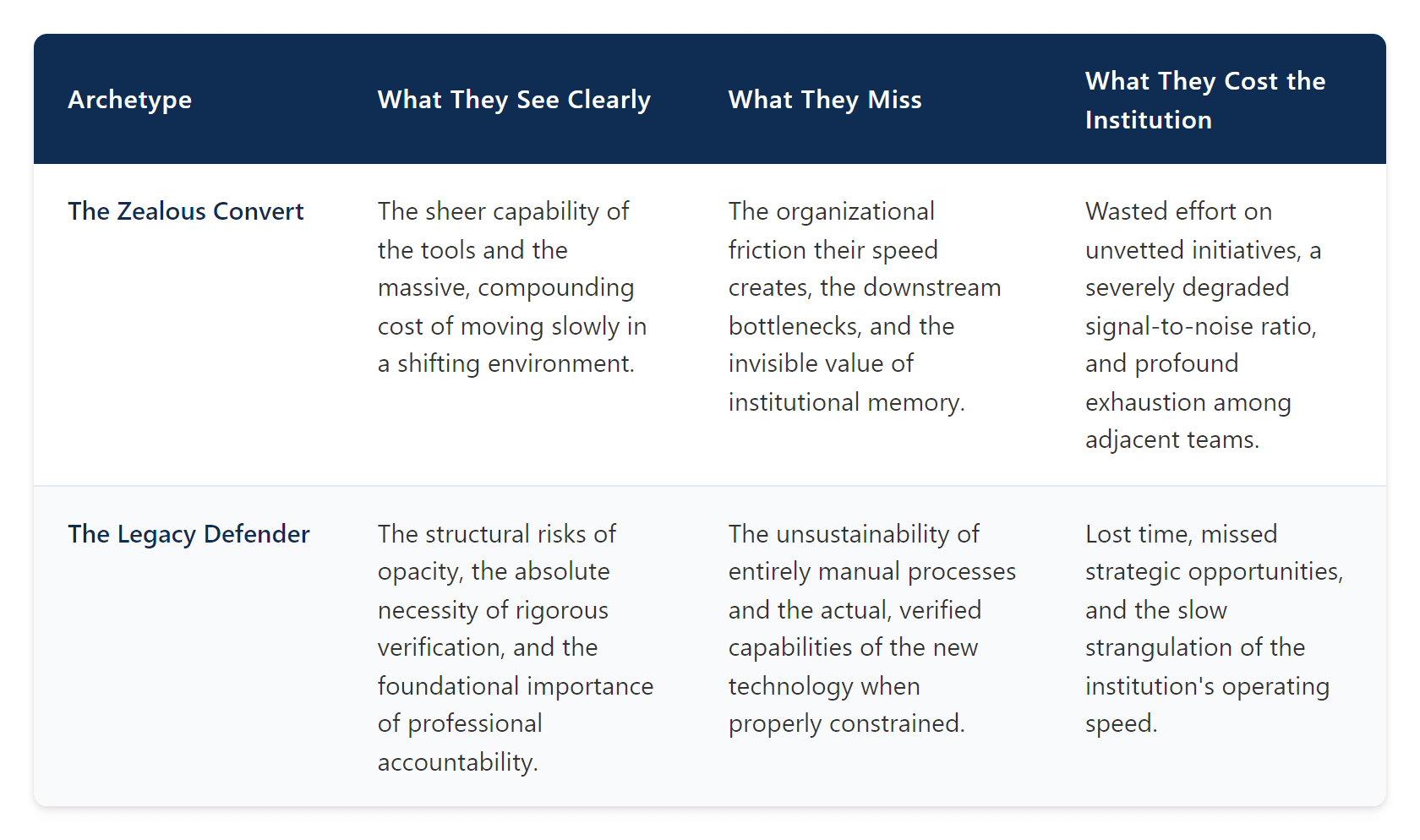
Ground Truth — What the Defenders Are Actually Protecting
To move beyond the stalemate, leaders must stop evangelizing the tools and start asking what the resistance protects. The Legacy Defender is guarding something vital that the Zealous Convert is willing to trade away for speed.
Institutions rely on epistemic hierarchies. The senior grants officer knows what the foundation wants, and the junior officer learns from them over time. When an AI system can instantly generate a proposal that perfectly matches the foundation’s stated rubric, the junior officer bypasses the senior officer. The machine becomes the epistemic authority. The foundation’s stated rubric rarely matches its actual funding behavior, and the senior officer knew the difference through years of uncodified relationship building. By shifting authority to the machine, the institution overwrites its deep, contextual Ground Truth with a shallow, statistical approximation.
Yanqi Sun and Cheng Xu gave this dynamic a name in their 2025 Journal of Knowledge Management work: hybrid cognitive authority. Their argument is that AI-generated communication does something stranger than assist: it simulates intent, and in simulating intent it begins to co-define what the organization treats as knowledge. The machine takes a seat in the institution’s decisions about what is known and who knows it, work that extends well beyond answering questions.
The consequence that quickly follows represents a shift in who counts as a knower. Because the AI consistently produces structured, confident, syntactically flawless text, its output arrives pre-dressed in the costume of expertise. Human workers with deep contextual understanding but slower, less polished delivery find themselves arguing against a frictionless consensus that no one in particular authored.
The Defender is guarding the institution’s epistemic ground against this marginalization. The bank consultants named the fear precisely. “I didn’t learn this job just to sit there in a purely accompanying role,” one said, describing a future in which the customer enters their own data and the consultant is, in his phrase, “rationalizing myself out of the equation.” Losing recognition as a knower is a real loss. When the machine’s output is treated as the default truth, the human professional’s hard-won expertise is demoted to a mere auditing function. The Defender senses this demotion and refuses the tool to protect their standing as a professional capable of exercising judgment, protecting the deep contextual knowledge the institution relies upon but cannot codify.
My own defense against this erosion is a practice I call “twenty minutes unplugged.” Every day, I spend twenty minutes entirely disconnected from the tools, working with a pen and a notebook. This is a deliberate severing of the dependency loop. I remove the screen, face a blank page, and force my brain to structure an argument without the scaffolding of an autocomplete or a generated outline.
The friction returns immediately, and that friction is the point. The cost of failing to do this is cognitive atrophy. You slowly lose the ability to differentiate between your own thoughts and the machine’s statistical predictions. The unplugged practice is how you verify that your cognitive engine still turns over on its own. This is the builder’s version of what the Defender protects. I need to maintain skills that owe nothing to the systems, keeping the tools from becoming load-bearing.
The Defender’s instinct is correct, yet their speed limit is unaffordable. An institution cannot survive operating at the pace of purely manual labor. The leadership mandate is to retain the rigor of the Defender’s position while rejecting their absolute refusal.
Architecting the Middle Ground
The solution to this stalemate is structural, rather than persuasive. That principle has evidence behind it: Ruchika Jain, Shikha N. Khera, and their colleagues showed as much in a 2022 Kybernetes study of human-AI work design for collaborative decision-making. They put participants through situational scenarios that varied the division of labor, whether the work ran in parallel or in sequence, and whether either party specialized, then measured the trust and role clarity each arrangement produced.
Their result should reorient every adoption conversation. Not one configuration they tested produced less trust in an AI partner than in a human one. What moved the numbers was the division of labor itself. Reluctance to work alongside AI turned out to be reluctance about badly designed work, and trust and role clarity followed the structure of the workflow rather than the identity of the partner.
Systems beat evangelism every time. Design the middle ground, and the adoption will follow organically. Leaders should quit lobbying Legacy Defenders to feel differently about the tools and start designing workflows that structurally guarantee human authority. By placing the AI in a subordinate, sequentially constrained position, the architecture automatically defuses the threat of opacity and preserves the professional accountability the Defenders are rightfully protecting.
The first architectural intervention is the Sandbox Protocol. This is the institutionalized version of the play project, characterized by scheduled, low-stakes experimentation with nothing due at the end. You schedule a two-hour block on Friday afternoon. The team is given a new model and told to try to break it, or use it to plan a fictional event. There is no performance review tied to the output. Skip this, and all learning happens on live ammunition: people try to learn the tools while simultaneously trying to meet a high-stakes deadline, which produces either catastrophic errors or immediate abandonment.
Yuushi Toyoda, Gale Lucas, and Jonathan Gratch provided the empirical basis for this approach in a 2020 crowd-work experiment on algorithmic management framing. They took the exact same algorithmic system and presented it to workers under two radically different conditions. One group was told the system was an autonomy-supportive tool designed for their own use, while the other group was told it was a control-salient manager monitoring their output. The researchers measured how these framing differences interacted with the perceived meaning of the task to influence worker motivation and agency.
The results showed that framing and meaning interact in a way leaders should find sobering. When workers experienced the task as worth doing, the autonomy-supportive framing boosted motivation. When the task felt pointless, it was the control-salient framing that squeezed out more output. The same system, worn as a different mask, produced different workers.
Read that finding carefully, because it cuts both ways. An institution that treats AI adoption as compliance (i.e., mandates, monitoring, high-stakes evaluation) is choosing the control mask, and it will get grudging output on work its people experience as meaningless. The Sandbox Protocol deliberately manufactures the opposite condition: exploration that matters to the explorer, under an autonomy frame, with the stakes removed. By taking away required output and evaluation, it gives workers the environment in which the autonomy framing actually pays — a safe place to build competence and discover the boundaries of the tool, bridging the gap between the Convert’s enthusiasm and the Defender’s caution.
The second intervention is the Baseline Audit. This is the unplugged practice institutionalized across the organization. Before a department is permitted to automate the drafting of their compliance reports, they must prove they can write the report manually, using only primary documents. They map the exact logic required. They codify the Ground Truth. The rule is absolute. No process is automated until the team can map and execute it unaided.
Ground Truth must be established as a policy, ensuring that the team retains the unassisted ability to perform the work if the tools fail. An institution that skips this step eventually forgets how it operates: when the API changes or the model degrades, the team is paralyzed, because the knowledge of the process was outsourced whole to the machine.
Sylvain Bruni, Mary Freiman, and Kenyon Riddle supplied the vocabulary for this middle ground in a 2023 paper in Human Factors and Simulation, aimed squarely at the tired tool-versus-teammate debate. Both prevailing metaphors, they argue, mislead in their own direction: the tool metaphor underestimates the active, generative character of these systems, while the teammate metaphor overestimates their reliability and their fitness for shared responsibility.
Their proposal is the sidekick: a partner that is simultaneously “doing” and “helping do.” The metaphor’s virtue is that it admits mixed agency without conceding equality: a sidekick has real, specialized capabilities and still answers to the lead.
Give your institution that word and both archetypes can finally stand in the same room. The Convert’s recognition of real power is honored: a sidekick is genuinely capable. The Defender’s demand for accountability is built into the grammar: a sidekick answers to the lead’s judgment, always. Professional identity survives the introduction.
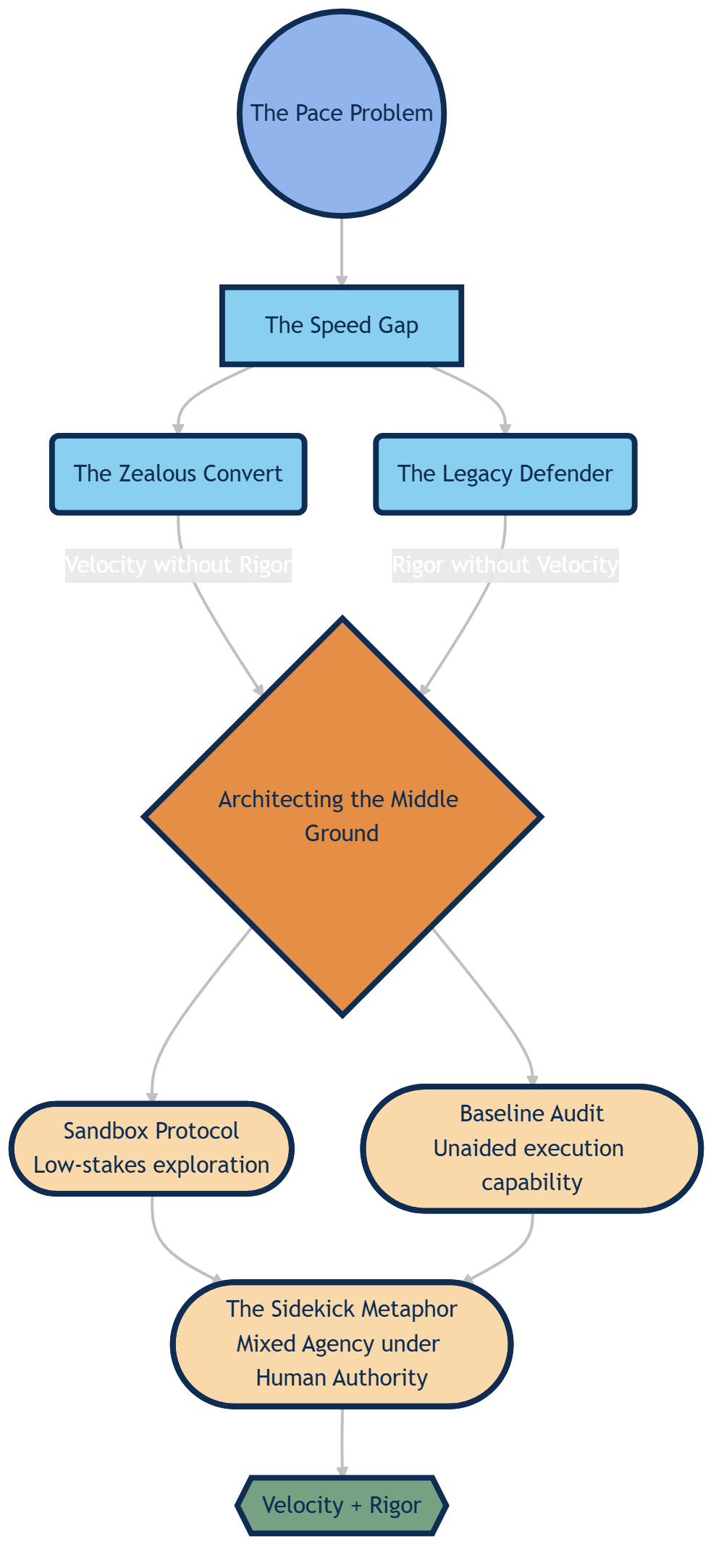
The Builder’s Mandate
The Builder’s Progression contains two distinct paths. The instrumental approach asks how to use the tool to do a current job twenty percent faster to go home early. It is a defensive optimization, driven by the fear of obsolescence, focused purely on advantage and keeping pace. The capacity approach asks a different question. If the drafting of the proposal now costs zero time, what completely new strategic initiative can be launched with the recovered hours? It is an expansion of the operational horizon, focused on expanding what the institution can think, make, and attempt.
Choose the instrumental path alone and the institution merely accelerates its current trajectory. If you are heading in the wrong direction, AI simply helps you get lost faster. The capacity path requires leaders to adopt the play project and the notebook as their own disciplines, not just policies they mandate for others. You cannot architect a system for your teams if you are entirely captured by the dopamine trap yourself. You must maintain the ability to step outside the assisted workflow to see what the workflow is actually producing.
A university’s mission is not writing syllabi. A non-profit’s mission is not writing grant proposals. They exist to educate, create knowledge, and solve intractable social problems. Yet, administrative friction consumes the vast majority of the human hours available. Every hour ground against legacy friction is an hour stolen from the actual mission of the organization.
Pace is morally neutral; it is merely a vector. The tools cannot answer what to build or why you should build it. The leader must reclaim the hours from the friction and redirect them toward the mission. The tools are ready. The systems have been designed. The friction points are known. The discipline required to manage the speed gap is the defining leadership test of this moment.
Adam, "Baseline Audit" is the piece I didn't have. I've been arguing, in essay form, that a tool handed to a hand that hasn't yet formed doesn't extend that hand's capability — it substitutes for the exact struggle that would have built it. Your rule — no process gets automated until the team can map and execute it unaided — is that argument turned into something an institution could actually adopt, not just agree with in the abstract. That's a real gap in my own thinking you've filled.
The bank consultants who started inventing reasons for loan denials rather than admit the machine's logic made no sense to them is the part I keep coming back to, though. It's the clearest real-world proof I've seen of what happens when accountability survives but understanding doesn't — you don't get better judgment, you get better cover stories. That's a sharper, more concrete version of a risk I could only gesture at philosophically.
Genuinely useful piece. Subscribing.
The clinical version of this speed gap is that faster generation does not automatically make the workflow faster. It can just move the bottleneck to review, source reconciliation, and ownership.
In an OR-adjacent AI system, the test would be whether the tool reduces unresolved handoff work: which source changed, who owns the exception, what still needs human review, and whether the next person can inherit the state without rebuilding it from scratch.